Surroundings
Cittadella del carnevale di Viareggio
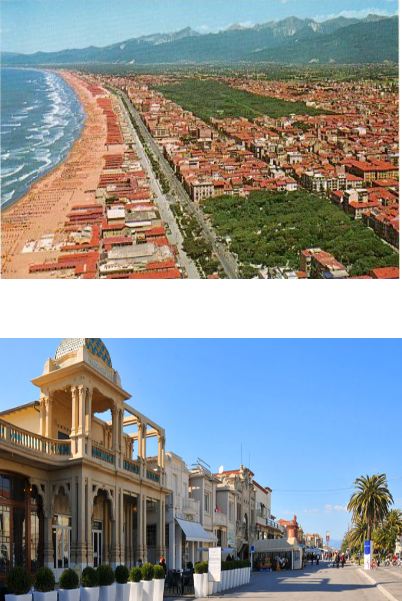
3 Km far from our hotel you will find the Cittadella del Carnevale, where all the famous Viareggio carnival carts are built. During summertime the cittadellla becomes an important stage for music and theatre shows (like the Giorgio Gaber Festival). 5 Km away there is the Viareggio tourist harbor, where you can admire the beautiful yachts that made Viareggio known in the whole world. Walking in the Viareggio promenade is a beautiful experience and offers a great view of both the entire Versilia Riviera and the Apuan Alps. For those who love fishing, the harbor is the ideal place to be.
Camaiore
8 Km far from the main town Camaiore, with a roman origin and in the centre of a very green dell with mountain peaks that are more than 1200 mt high and studded with ancient mountain villages - Pedona, Metato, Torcigliano, Peralla, Casoli, Trescolli, Greppolungo, La Culla, Monteggiori, Santa Lucia – from which you can admire stunning panoramas. The CAMAIORE valley is worth visiting not only for its villages, but also for its natural treasures. A paths net that allows you to reach the valley resorts or the highest peaks like Monte Prana, Monte Matanna, Monte Gabberi, enjoing the coast view - from the Elba island to the five lands with Versilia at its feet. The Candalla gorges are so beautiful and wild, with a mountain stream that flows creating pools and water fallings where many people go to refresh themselves during the hot summer. It is also possible to visit the old iron industries, located in this place in order to take advantage of the water strength to shape the iron. Free climbing lovers will find this place and Greppolungo, Sant’Anna, Casoli a very good training place because of the area and the difficulty level. From the Casoli village it is possible to reach the Onda cave, prehistoric site location.
Pietrasanta
7 km far from our hotel there is PIETRASANTA, roman town called the little Athens, where artists and students from all over the world gather to learn and teach the sculpture art – and where to walk in the pedestrian streets in the centre or in Piazza del Duomo, admiring Botero, Mitoraji, Yasuda’s and world’s famous artists’ masterpieces.
Forte dei Marmi
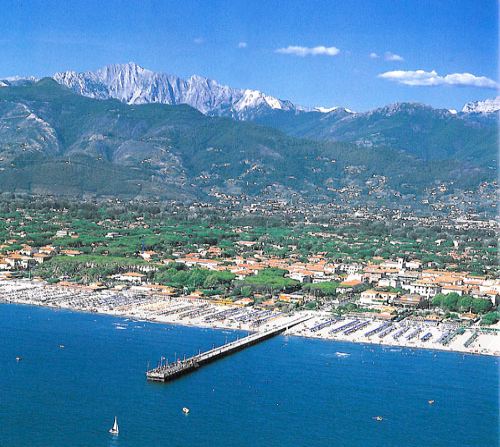
7 km far from the hotel there is the exclusive beach resort of FORTE DEI MARMI – place chosen by VIPs in order to stay for the holidays. Nearby there is the Golf Club Versilia, a 18-holes green, between the beach and the Apuan Alps slopes. There is also the training field Folf Club Alisea, 2 Km far from our hotel.
Torre del Lago Puccini
This town is 11 km far from the hotel and is the place where to go and visit the Giacomo Puccini ‘s home-museum or visit the Massaciuccoli lake with a boat. On the lake there is the new open air theatre where, during the summer - between July and August - is taken the Festival Pucciniano, dedicated to perform Giacomo Puccini’s works.
Seravezza
Seravezza is the visit centre of the Apuan Alps park, 15 Km far from our hotel. It the starting point to make excursions in the south apuan valleys, with beech and chestnut tree woods. Pania della Croce, monte Forato and monte Procinto are very famous. When the weather is very hot, don’t miss a bath in the cold Desiata pools, a unique place shake by the water flowing from the Altissimo mountain.
Marble Quarries (Carrara)
In the Apuan Alps the spectacular marble quarries offer an evocative sight. Here this precious white stone has been excavated since Roman times. Since then, it has been used for all sorts of different purposes: from the simple objects to more famous works of art and architecture.
In the past the blocks of marble were carried to the plain with an ancient manual technique called “ Lizzatura” which is recalled each year thanks to the courage and skill of the last living “Lizzatori”.
Five Lands
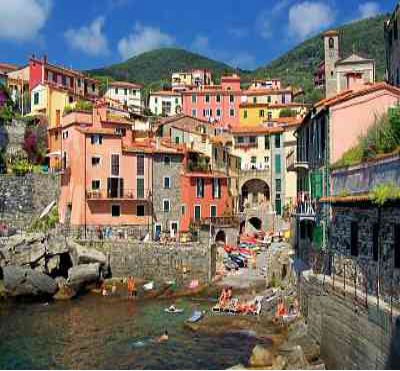
The charm of the hill overhanging the sea, a wonderful choreography that seems to have been designed by a romantic painter who traced an extremely intense painting, a treasure, vaunt of the Province of La Spezia, destination for tourists from all over the world.
Houses and paths suspended between the earth and the sky, make it a natural beauty unique also because kept intact and faithful to the nautical tradition.
Pisa
Situated on the banks and by the outlet of the river Arno, it had been one important Republic of the Sea and spreaded its power out to Corsica isle. Its decadence has been determined by both the rivalry with other cities belonging to the inland (Lucca and Florence) and, most of all, by the clash with Genova, another Republic of the Sea and a "dangerous" rival in oriental trading.
Lucca
The city of Ilaria, the unfortunate bride. Lots and lots are the definitions of Lucca, one of the more distinguished italian cities comparable to a costly case containing invaluable historic and artistic treasures. Mario Tobino's is the definition we prefer: "Why do you love Lucca so much? Because it is a village. Although its marbles, its sky is light.". These two lines underline the integrity of a historical-centre perfectly enclosed by a town-wall that has always been kept intact.
Florence
A city of about half a million inhabitants, Florence is situated on the bank of the river Arno, between the triennia sea and the Adriatic sea, more or less in the centre of the Italian peninsula. It is a lively city as regards the industrial and artisan activities, the commercial and cultural exchanges, the artistic and scientific life. Florence preserves an excellent artistic property witnessing its centuries-old civilization.
Siena
is the city of the Virgin and of the so-called Balzana and it is divided into two factions: the White and the Black. It is a city not fond of mediocrity, just like its heraldic symbol witnesses. Siena is passionate and contemplative, everlasting on the climb and sloping-down, clear and dark. The red shade characterizing Piazza del Campo appear dazzling and unexpected from the lanes more narrow and precipitous.
Volterra
Located in the heart of Tuscany, at about 40km from the sea and at a short distance from the three Tuscan universities as well as the most important cities of art of the region (Firenze: 72 km; Siena: 50 km; Pisa: 64 km; S.Gimignano: 29 km), Any tourist must visit Volterra, which is also an ideal place for studies of every level and for relaxing holidays in a very suggestive landscape.
Lunigiana
Lunigiana owes its name to the town of Luni founded by the Romans in the 177 B.C. near the mouth of the river Magra. Today it identifies itself with the valley of the mentioned river and its affluents, while its historical border is more wide. Lunigiana is situated between Tuscany and Liguria, whose peculiar features it reproposes especially in the landscape , in the cultures, in the architecture and in the friendliness of its people.
Elba Island
Has been the theatre of big historical events. Every Mediterranean civilization has left important marks of its own landscape . Elba was an inexhaustible mine for Etruscan people who exploited the mines and exported the iron all over the Mediterranean sea. After 5 centuries of Etruscan domain, various necropolises remain as well as some blast furnace’s ruins and numerous villages. The Romans appreciated Elba for its iron but also for the mud baths as testifies one of the two rich patrician villas, of which ruins are in the nearby of the present termal structure.